


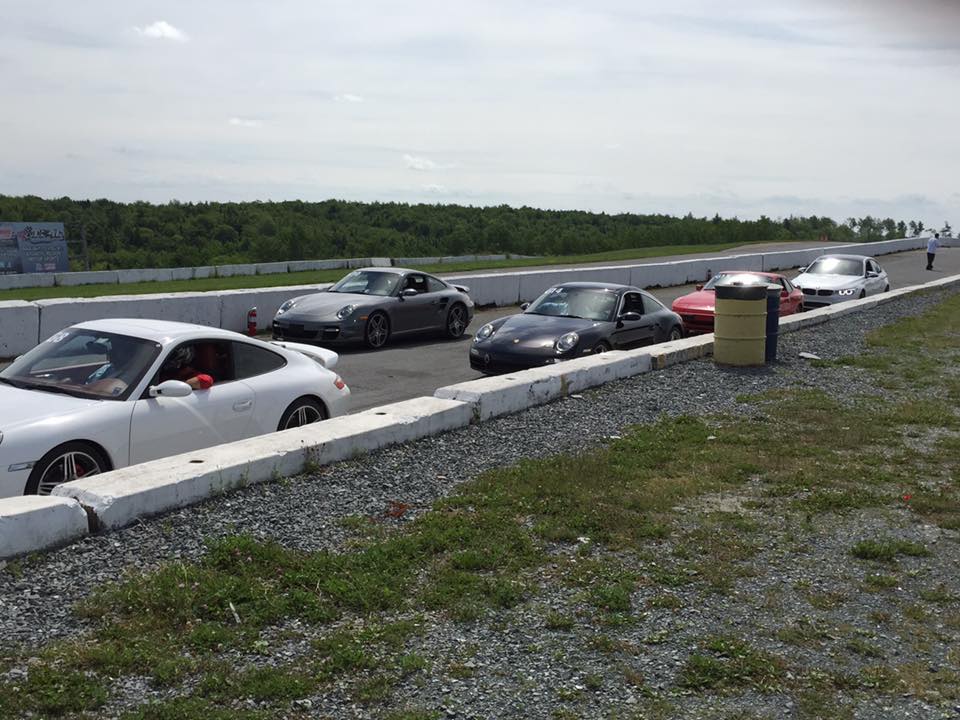
Last week, I spent another couple of days at our track with the local PCA to participate in their annual High Performance Driving School (Track Daze - link here). There was great turnout with plenty of cool cars, including the new 991 GT3 RS in the picture below, which you can also see (and, more importantly, hear) pass me in the video at the end of the post at 5:55. Weather did not disappoint either, presenting us with a dry track for two full days. This is the first time I have been able to attend, as PCA run their schools on weekdays and I wasn't able to find time the last few years. Luckily, this year, I planned it well in advance and made it there.

The school has four run groups - Green for novice students, Yellow for intermediate students, Red for advanced students and newer instructors, and Black for experienced instructors. The local BMW club - BMW Club Atlantic - also arranges HPDS's (Advanced Driver Training - link here), which I have been going to since 2011 and where I started high performance driving. They have an identical run group setup, with one trivial exception of intermediate student group being "Blue" instead of "Yellow". Since I run in the Red group in the BMW club school, I requested the Red group in the application form for the PCA school and that's where I was placed.

Both events are huge fun, with a great group of like minded people. I have also said a huge part of the fun of the BMW club school is the social part and the Porsche club school is no different. The main difference between the Porsche and BMW clubs' schools is the exercises. The BMW club school starts off with two sessions of slaloms, emergency braking, and threshold braking. After that, you get to the open lapping sessions. The Porsche club school does without the exercises sessions and goes straight to lapping sessions. Which one is better? It depends. Porsche club school has more track time. I think the BMW club school is more suited for beginner and intermediate drivers. The slalom, in particular, teaches a lot about the behavior of the car - its balance (i.e. understeers, oversteers, or neutral), its transitional response and how quickly it loads and unloads, grip levels, steering response and effort, etc. Threshold braking (max braking from 100 km/h or ~ 62 mph) also helps a lot to get a feel for the car's braking power.
You can easily learn all these things from lapping alone, but there's a lot of information to take in during a lap for a beginner and I think learning these things separately is a great help and speeds the learning process. The quick transitions of a slalom can also amplify car strengths and weakness and is great. On the other hand, practice and seat time is invaluable so the additional lapping sessions are a huge help, and not to mention fun. There are great instructors at both clubs and quite a few instruct at both so you can't go wrong. If you don't know how to decide, go to BOTH! You won't regret it. Anyhow, back to the Porsche club school.
I was assigned Jay Barthelotte as an instructor, who you might remember as my team mate for the 95 GTI race car. Typically, the first thing you do is get to know the instructor and he/she you and discuss your goals for the day/event but since Jay and I know each other well as far as track experience and goals, he just strapped in and we went for our session. I had to adjust from the race car. Most of the lines are the same (defensive racing lines notwithstanding), but turn in points, braking points, and throttle roll-in are very different so it took me about two laps to re-familiarize myself with the car. Jay didn't say much, as he knew what was going on.
At the end of the session, I asked him for feedback and he said not much - just try to use more of the track in exit of turn 2, and later entry into turns 5 and 11. He gave me a few pointers about areas where I could be smoother as well and then left me to my devices for the rest of the day. Before the last session of the day, though, I asked Jay if he wanted to come along and he did. The session went great. I asked him if he had feedback and he said "Hard to critique that." I was pretty happy about that, thanked him, packed up my stuff, and headed home.

We were a little worried about the weather on the next day because it had rained a lot overnight but the track dried in time for the first session. I was able to get that session on my GoPro. I wanted to get some sessions from the first day but there was a requirement to tether the camera to something in the car in case the suction cup fails and I didn't have anything so I had to wait until the next day.
After this session, I asked Jay if he had any critique and he said no, they were great laps. I asked him to nit pick and he said I could use a little more of track in exit of 5 but I was leaving that on purpose. I unwind a little more slowly with a little less throttle than I could, although I do that on purpose, to leave some room for error since the car gets unloaded at the crest of 5 and the back end can come a little loose so I want to have room for error to catch it if it goes. There are a few other places where I could use more throttle that I'm still being a bit cautious about to make room for error, such as exist of 2, corner 8, and exit of 11. He said it's very hard to critique, again, and that all inputs are smooth and progressive. Most importantly, though, he said I do section 3 to 4 very well and "could teach a course in corner 3." Of course, what he meant is that corner 3 is basically maxed out. What I heard was very different and more along the lines of "You are the BEST driver I have ever SEEN!" I am still working on convincing myself of the former.
There are other places too where I am holding back simply to preserve the front tires, especially corner 4 and corner 9. The problem is that the car has a lot of grip (perhaps a very good problem to have) but when combined with a heavy curb weight and front end weight bias, you get a lot of tire shoulder wear. The problem is exacerbated by soft bushings, which are great for ride quality but awful for maintaining front end geometry under load. Camber and wider front tires helped the problem dramatically but those simply allowed me to go quicker, undoing all of the help so I am learning to hold back until I get stiffer front control arm bushings, wider wheels and tires, and probably some weight saving. For a detailed list of car setup (it is mostly stock), check out the My 2012 Mustang Boss 302 Progress post.
To make a good couple of days even better, I ended up winning a draw for a $200 gift certificate redeemable at ISI Automotive (read about my first visit here).
There's another event in September with the Porsche club, although it is a one day event unlike this one. It has no classroom sessions and even more track time so I'm really looking forward to it and hope to make it.
Photography by Jeff Sandal


hi
ReplyDelete